
Article Information
Category: Personal
Published: 17 March, 2026
Author: Chris de Gruijter
Reading Time: 7 min
Tags
Reaching 2400 Bullet on Lichess — and Beating a 3000+ Rated Player
Published: 17 March, 2026
I have been playing chess online since I was 13. I am 38 now, so that is 25 years of online chess across platforms like Spelpunt.nl, Playchess.com, ChessCube, Chess.com, and Lichess. For most of that time I played casually — fast games, lots of bullet, always enjoying it but never thinking too much about ratings. Then recently two things happened that I feel compelled to write about: I hit 2400 bullet on Lichess, and shortly after I went 2-2 against a 3000+ rated bullet player. I still can't fully believe the second one happened.
Where My Ratings Stand Right Now
On Chess.com, my current ratings are:
- Bullet: 2300
- Blitz: 2100
- Rapid: 2000
- Daily: 1975
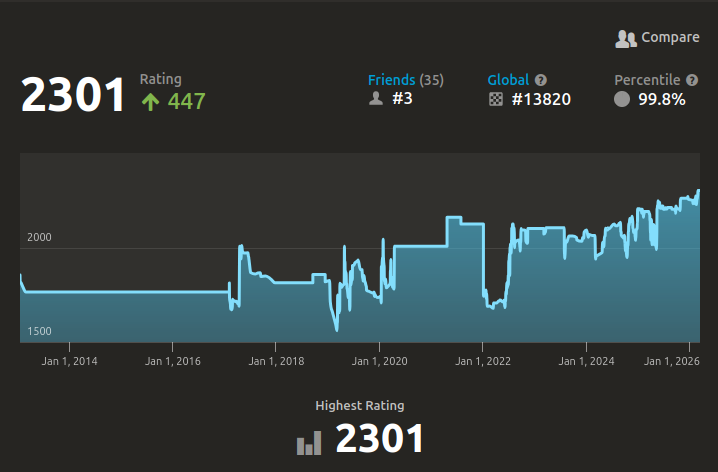
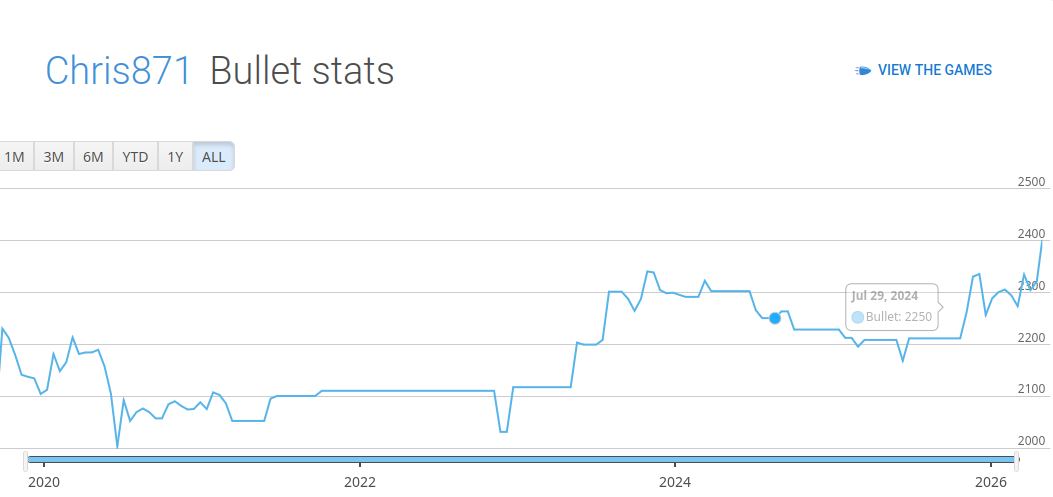
On Lichess, I recently crossed 2400 in bullet. That felt monumental. I honestly never thought I would get there. I had always floated around the 2200–2300 range and assumed that was roughly my ceiling. But the 2400 came, and now I am starting to think 2500 might actually be within reach.
A small but amusing "career goal" of mine has always been to have a 2000+ rating across all four time controls on Chess.com — rapid, blitz, bullet, and daily. I have three of the four. Daily chess is the hardest for me despite being the slowest format, because I play it much less frequently. I am currently rated 2000 in the global daily leaderboard on Chess.com, which places me in the top 0.1% of all daily players. That said, daily is the one I expect to take the longest to crack.
The Titled Players I Have Beaten Over the Years
Across 25 years of playing online I have managed to beat players of almost every FIDE title:
- CM — Candidate Master
- NM — National Master
- FM — FIDE Master
- IM — International Master
- GM — Grandmaster (once, in a bullet game on Playchess.com — still one of my most memorable wins)
- WFM — Women FIDE Master
The ones I have not yet beaten are WCM, WIM, and WGM. I am in no rush — these things happen organically when you play enough games. The GM win was a one-off in a bullet game and took me 20 years, so I am not holding my breath.

Fast Chess: Bullet, Ultra-Bullet, and Hyperbullet
I have always been drawn to fast chess. My favourite format is 1+0 bullet — one minute per side, no increment. Lately I have also been playing a lot of 30-second ultra-bullet games, and even some 15-second hyperbullet.
Hyperbullet is barely chess in the traditional sense. At 15 seconds per side, you are not calculating variations — you are moving on instinct, playing patterns, and trying to steal time from your opponent's clock by any means necessary. One of my favourite tactics at that speed is sacrificing a queen just to give check. Yes, you end up in a clearly losing position on the board, but if you manage to take a second off your opponent's clock in the chaos, it was worth it. It is a cheeky extra dimension of the game that I genuinely enjoy.
That said, 1+0 and 30-second are my bread and butter.
The Chess.com "Top Players in the World" Page
This is a funny side note. I recently Googled my own name and found that Chess.com has a page for me titled "Top Chess Players In The World." I had to laugh. I think Chess.com auto-generates these pages for anyone who has a FIDE profile, so it is not really a brag — but there it is, my name on a page that says "top chess players in the world." I'll take it.

The 3000+ Match: Four Games Against a Super-Rated Player
Now for the main event. A few days ago I was browsing the Lichess lobby when I saw someone rated 3000+ seeking a 1+0 unrated game. I said out loud, "wauw." A 3000-rated player in bullet is what you would call a super-GM level at that time control — even if they carry no official title. I immediately accepted.
Before the first game started I typed in the chat: "teach me sensei." He never replied.
Game 1: A Loss, but an Honest One
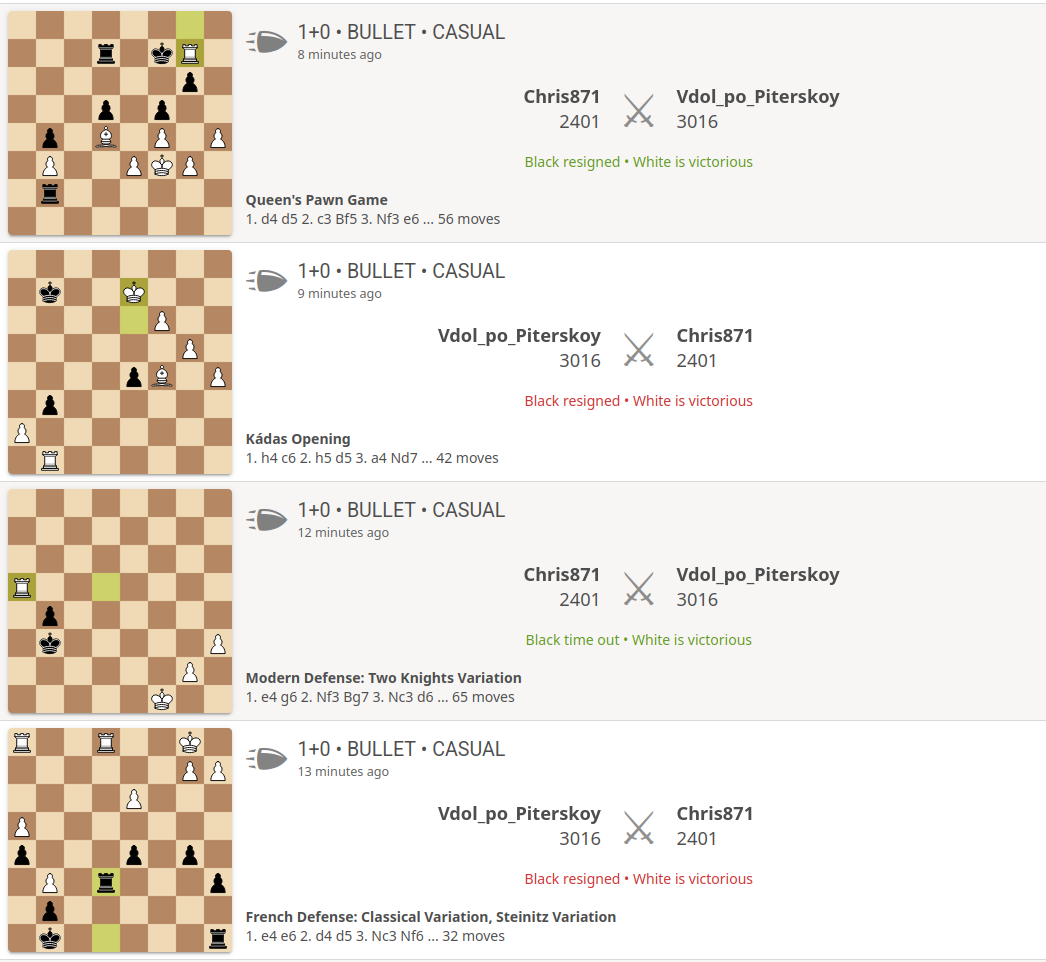
I resigned after 32 moves in a clearly lost position. Honestly, I was still in a bit of shock at having the opportunity to play a 3000-rated player, so my focus was not quite there. I made mistakes, got punished for them, and resigned. No shame in that.
Game 2: A Win — I Flagged Him with a Rook Up
This was the game that put me on cloud nine. After 65 moves I had a rook and two pawns against his lone king and one pawn — a completely won position. I flagged him with 2 seconds on the clock. I had not expected to win even one game. Winning this one already felt like more than I could have hoped for.
Game 3: He Opened with 1.h4 and 2.a4
He started with 1.h4 and 2.a4. Whether he was playing around or just not taking the match seriously after losing game 2, I am not sure. I tried to play normal chess, but ended up in a bad position early and lost after 42 moves. Fair enough.
Game 4: He Resigned — Final Score 2-2
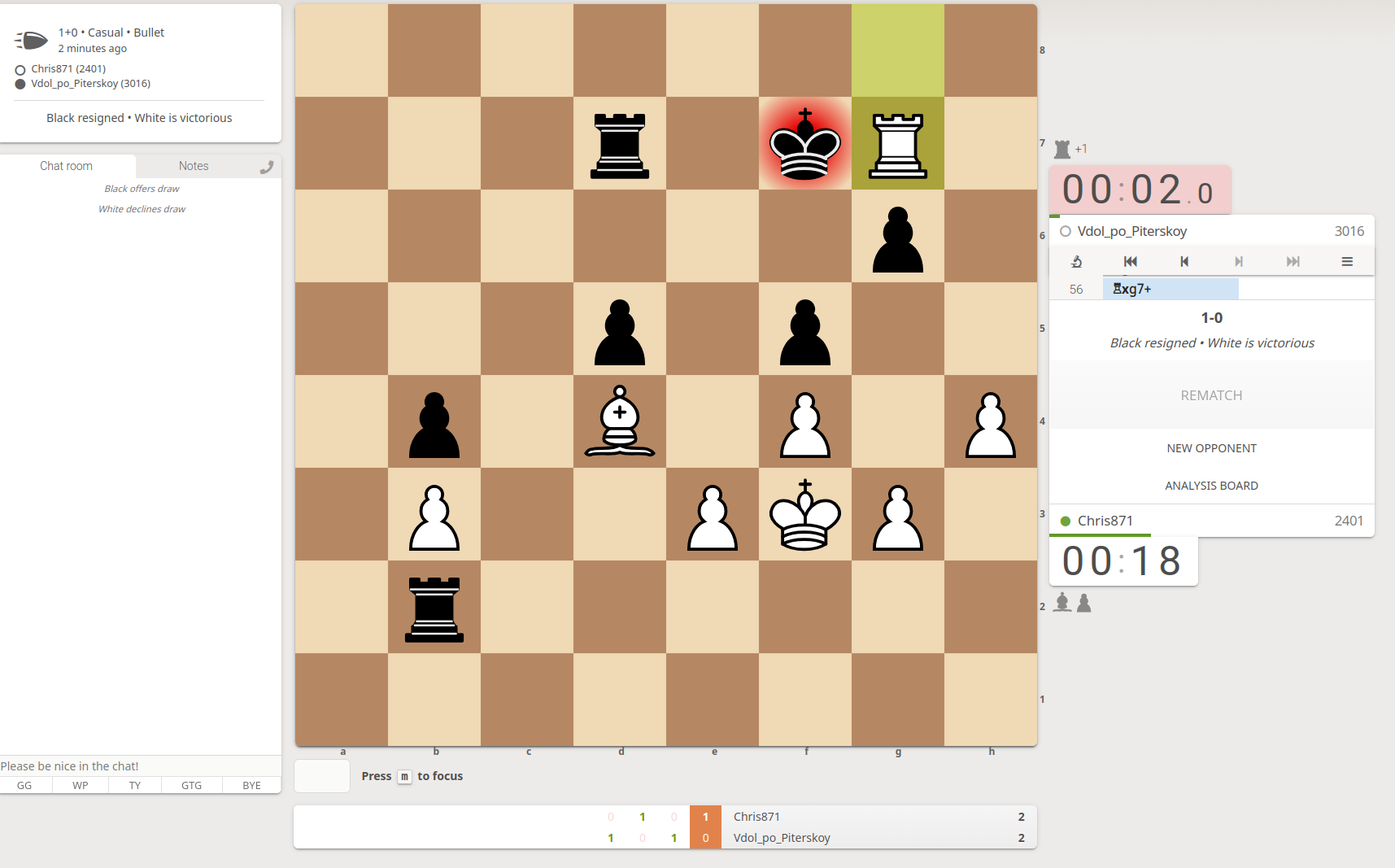
The fourth game was chaotic — we both blundered, which at bullet speed is not unusual. But I had the better clock with 167 seconds ahead of him, and my position was winning. He resigned after 56 moves without seeing that I had also blundered. The final score: 2-2 against a 3000+ rated bullet player. I genuinely could not believe it.
What I Noticed: Avoiding Trades to Keep Things Complicated
One thing I immediately noticed during these games is that my opponent — like other high-rated players I have faced — actively avoided trading pieces. He kept as many pieces on the board as possible in order to keep the position complicated. This is something I consistently see when playing against stronger opponents.
In quick bullet games against players rated below 2200, trading pieces is common. Simplification happens naturally. But higher-rated players deliberately avoid it. They know that complexity is an advantage — more pieces means more tactical opportunities, more chances for the opponent to blunder under time pressure, and more ways to outplay you positionally. Considering this pattern, I think the fact that I managed to go 2-2 against him says something about how my own game is developing.
What's Next: Aiming for 2500
2400 already felt like something I might never reach. And then it came. Now, looking at what just happened against a 3000-rated player, I am starting to genuinely believe that 2500 is within reach. I know that is a long way from 2400 — each hundred points gets progressively harder — but belief matters in chess, and right now I have it.

I will keep playing, keep enjoying it, and see where the rating goes. That is the only plan I have ever had.
Frequently Asked Questions
What is bullet chess?
Bullet chess is a fast time control where each player has 1 minute (or less) for the entire game. The most common format is 1+0 — one minute per side with no time increment added per move. It rewards fast pattern recognition, intuition, and clock management as much as calculation.
What is a 3000 rating in chess?
On platforms like Lichess, a bullet rating of 3000+ puts a player firmly at grandmaster level for that time control. Lichess ratings are generally slightly inflated compared to FIDE classical ratings, but a 3000 bullet player is undeniably world-class at fast chess.
How long does it take to reach 2400 bullet?
That entirely depends on the individual. I have been playing online chess for 25 years and this is the first time I have crossed 2400 in bullet. For others with a classical chess background it may come faster. There is no shortcut — it is pattern recognition built over thousands of games.
What is hyperbullet chess?
Hyperbullet is an unofficial term for extremely fast time controls, typically 15 seconds per side. At this speed, chess becomes almost entirely about physical speed and clock management. Tactical sacrifices that steal time from the opponent's clock are common even when they leave you with a losing position on the board.